Clu 1: Dogged and Relentless, Loyal and Brave (Part 4)
Moving on to the next scene, we see Clu, after his capture, brought before the MCP. The Memory Guard gives his report on Clu and his illegal activity. Clu intervenes, claiming he was in the high-clearance memory by mistake, but the MCP ignores him and questions who created Clu. In return, Clu ignores the question and continues trying to ‘plead’ his innocence.


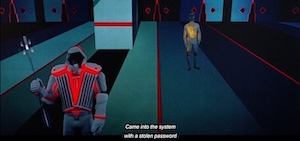
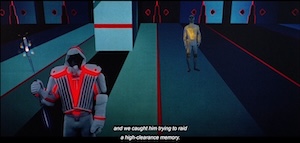

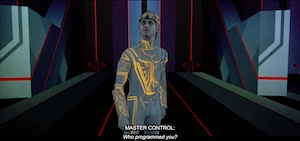

In this scene, another trait is present: deception. Since Clu has a mind for strategy and doesn’t give up easily, it’s apparent that he is using another approach to get his way out. Hence, his use of deception. Deception is often most effective when it contains hints of truth. It’s most likely why Clu honestly gave his name, to try to paint a different picture of himself, which leads to him giving a story of his innocence. His playacting is also supported in the novel and script. Daley reveals that it’s a shared trait with his User that Clu plans the act of deception.
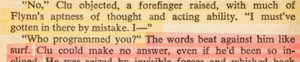
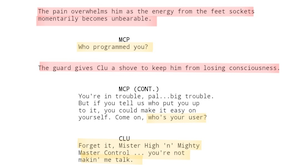
Even in the script, while he was actively tortured, Clu persists (another show of his perseverance) in attempting the deception.

Secondly, Clu displays a quiet personality trait here: irreverence. This is another trait shared with his User, as revealed in the novel before. Irreverence is defined as “a lack of respect for people or things that are generally taken seriously.” There are multiple ways one can act disrespectfully to someone, even subtly. The MCP is a highly recognized entity for his power and control over the system and its programs. It would be respectful to answer the MCP’s question directly. However, Clu flat-out ignores the question, which is a disrespectful and daring choice. His posture is straight and bold, a quiet defiance towards the MCP (but it also shows his fear. His body is too rigid, and he falters when the MCP asks about his User, but he bravely continues the act.).
However, both of these actions, along with the evidence piled against him, proved to be the wrong move for Clu. With the use of his power, the MCP flings Clu into the wall, where he is tortured. Clu screams out in agony, and he starts to pixelate from the damage. His circuits turn red to reflect the hidden damage and his dire health.




The MCP is onto him. The farce is up. The mask is off, and Clu reveals what he truly feels towards the MCP after what he did to him: anger. And yet, as the MCP continues to question him, the anger quickly gives way to a wide range of emotions flittering across Clu’s face.


The anger gives way to despair and then to acceptance. But then, as the MCP asks once again, 'Who’s your user?’ Clu reacts loudly and mocks the MCP, refusing to give up his User’s name. The bravado, however, quickly gives way to his despairing acceptance as he affirms that he will not break, no matter what the MCP does. A tear leaks out from the corner of his right eye.
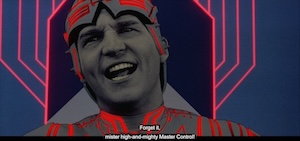


With the mask off, there is no point in hiding his intentions and his emotions. It’s clear, in this moment, Clu realized it’s game over for him. His strategies are used up, and there is no getting out of this, which is why he quickly falls into despair and acceptance. And yet, when the MCP asks for Clu’s User, he refuses to answer. It would be understandable to give an honest answer when one is faced by their own certain death, and Clu isn’t immune to the fear of death, as Daley reveals his fear during this scene.
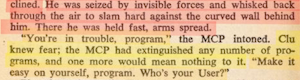
However, we know from the very beginning where Clu’s loyalties and beliefs lie. The Users. His User. Clu refuses to betray his loyalty to his User, choosing to protect him instead by refusing to answer (as he did before when he ignored the first question). Clu’s quiet irreverence becomes loud(also seen before, when Clu mocks the Recognizers in the novel and script), defying and mocking the MCP. Both the script and the novel reaffirm this. In the script, Clu perseveres under torture, refusing to answer and mocking the MCP at the same time.
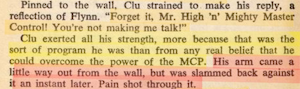
In the novel, Clu once again boldly refuses and mocks the MCP. Daley, again, ties back the irreverent action and defiance to the reflection of his User. Clu even fights back, trying his best to resist the MCP’s power over him, despite how fruitless it is to do so and the pain it gives him in return.
This one small moment is a perfect encapsulation of Clu’s character. He is brave and loyal in the face of his certain death. He perseveres under the pain and refuses to betray Flynn, steadfast and caring enough to protect his User’s name. And, like his User, he shows his disrespect and defiance to the MCP, a powerful authority figure, at the same time.
Continuing, despite this sudden bravado, it gives way to his despair and acceptance once again. At the corner of his right eye, a tear forms and leaks out. Clu is afraid and knows his end is coming at the hands of the MCP because of his boldness and defiance. He is most likely thinking about how he failed his mission and his User once again, but this time, permanently.
And yet, when the MCP decides to end him, at the last moment, Clu throws up a cocky grin. In the end, he protected his User. He won in his own way.

And then, the MCP delivers the final blow and, in agony, Clu derezzes. This is the last we ever see of Clu 1.



In conclusion, there is more to Clu 1 than what appears at first glance. With the helpful texts of Daley’s novelization and Lisberger’s fourth draft script, we see an expanded view of his character. Clu 1 is dogged and relentless, as Flynn has described him, but he is also faithful and loyal to his User. He is irreverent to authority, except his User. He is cautious but brave in the face of his fear and uncertainty. He is also skillful, quick-witted, and caring of those close to him. With all this in mind, the fundamentals of Clu 1’s character are present and can be useful for creative liberty. After all, the death of programs has never stopped the fandom community from rerezzing them before.
Sources:
Tron (1982) Film
Brian Daley’s Tron Novelization
Steven Lisberger’s Tron Fourth Draft Script
Credit:
Main Writer - @allcat09
Beta Reader - @br00kthe0takuuuu