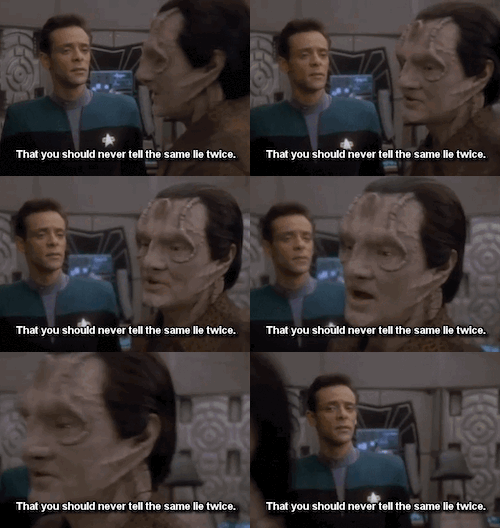
Garak’s interpretation of the Boy Who Cried Wolf story (“the moral is actually that you shouldn’t tell the same lie twice”) is ….really interesting on a couple levels.
Because at first, I was like… wouldn’t multiple different lies be less believable?
I mean. The story that the boy told requires only one assumption: “there is a wolf that sometimes tries to attack the sheep but runs away when it hears the townspeople coming."
That is very realistic! It fits the facts so well that for all we know maybe it wasn’t even a lie! Maybe it was just the facts, and the townspeople were at fault for what happened when they stopped believing it!
But, if the boy had alternated among several different stories to get the townspeople to come running up there ("there’s a bear!” “one of the sheep is sick!” “I was bitten by a snake!” “look at this weird plant growing here, is it dangerous?” “I saw a band of robbers!” etc)
…that would have required so many different assumptions– some of them easily disprovable– that everyone would have stopped believing him much sooner.
Right?
…Well. Actually.
Think about real-life excuses.
If the reason you give whenever you’re late to work is always the same health problem — that is extremely likely to be true! Chronic health problems do tend to have the same effect on your life, again and again and again! And so do other chronic problems in life!
But people are actually not very likely to believe that. They’ll be like: “isn’t it too much of a coincidence that this SAME thing happened ALL these times?”
And they’re more likely to believe if you cycle between a lot of different reasons.
Health problem, late bus, alarm clock didn’t go off, sick kid, sick dog, lost the keys, car broke down, household appliance broke down, mugged on the way to work, etc, etc….
Countless different completely unrelated events! All, somehow, just coincidentally, conspiring to have the exact same effect of making you personally late to work!
….But never the same lie twice.
So– to the convoluted logic of the average human mind– much more believable!

…smh.