 ALT
very particular experience with having a super-creative mind but very very distractible attention and memory…
The “I know I once saw this specific post/story/movie/etc and I remember several details about it, but not enough to find it!” feeling… except about one of your own ideas that you haven’t done anything with yet.
Latest for me:
- I know it was an idea about a humorous attempt to interpret an ambiguous detail in a particular old piece of writing.
- it would take the form of an essay in a very dry academic voice, starting out by mentioning a certain apparent inconsistency in the material
- followed by suggesting examples of how this detail could be interpreted to make sense– several examples, each progressively more silly and ridiculous, but all still technically capable of resolving the ambiguity or inconsistency being described
-I think the writing was something very old, possibly Greek or Roman mythology. and I remember being pretty confident the ambiguous detail was not clearly explained in any version of the source material… nor was it a thing that only became ambiguous through the lens of modern language/culture
- it was just something so weirdly specific that I doubted anyone but me would ever think about it, in any era
but I do not know. That’s just how I remember thinking about it at the time. I cannot remember any of the actual details and it’s making my damn brain itch.
So.
…the good side of this is, I always know the thought will eventually resurface… because my brain makes connections, and all things are connected, and I will eventually think of something it is connected to
the bad side is, it might not be quite as good as I thought it was the first time around.
It turned out this was a thing I have mentioned before, on occasion. It was about the Minotaur in the Labyrinth.
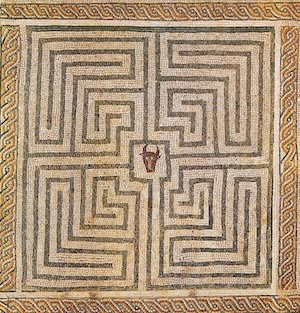
ALTand the fact that a “Labyrinth,” by the proper definition, differs from a “maze” in that it doesn’t have dead ends. You can escape a Labyrinth without ever having to turn back and retrace your steps.
this initially raised the question in my mind of why the Labyrinth was effective, since theoretically such a thing would be much easier to escape than a regular maze.
in the above mosaic, the minotaur is shown at the center of a Labyrinth in which there is only one possible path. If he left and just continued walking, turning whenever the path turned, it would be impossible for him to get lost, and he would eventually reach the exit.
so, why does he stay?
one possible answer: he is daunted by the length of the journey.
Creating a path that folds in this way gives it vastly more length than one would ordinarily have to travel to get out of an area this large– in the same way that a fractal antenna pattern can fit, on a small area of circuitboard, what once would have had to extend into a TV’s rabbit-ears.
so I imagined that perhaps the Minotaur’s escape is limited by his need for food and water.
These are only provided in his central habitat… where he could theoretically load up supplies for the road, but he might face challenges exceeding those of rockets that must reach escape velocity while carrying sufficient fuel to do so.
assuming some values of distance and minotaur biology, he might be trapped by simple inability to carry sufficient provisions for the length of his travel.
Or, perhaps he is trapped by the fact that he does not know how long the journey is. A bull’s head doesn’t have that much brain-space for theorizing, I imagine.
maybe he simply gives up and turns back, after an amount of walking that convinces him he’s never going to get anywhere. He’s got no reason to believe it will be worth the effort.
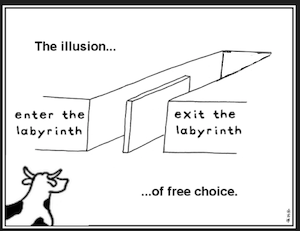
For all he knows, the whole thing might just be a double-edged axe of cattle-slaughter– might do nothing but turn around and bring him back where he started:
 ALT
in the same way that Pasteur’s swan-neck flask prevented the movement of microbes without presenting them any actual barrier.
…not to mention that this is all he’s known for many years. If he has any memory of the world outside, he doesn’t even have much reason to believe it’s better than where he is.
but, speaking of the outside world: why do Ariadne and Theseus need a ball of thread to navigate a Labyrinth with only one path?
the only answer that occurs to me is that the thread is more of a measurement device than one of navigation.
If indeed the path of the Labyrinth is too long for a Minotaur to traverse without starving… then it is probably also close to that limit for a full human with all the provisions a human can carry. And it’s likely longer than any ball of thread, too.
so the thread’s purpose would be to help keep track of how long one’s been traveling– to ensure optimal careful usage of supplies, and avoid death from starvation or dehydration along the way.
you unroll it as you go, and when it runs out, you roll it up and start again. If you’re Theseus, and Ariadne has assured you that the whole path is, for example, six thread-lengths long, you then have an idea of just how much longer you’ve got to make your food and water last.
So at this point, it felt to me that the plothole had met its match in the form of my headcanoning talents.
However, Wikipedia disagrees with me:
“Although early Cretan coins occasionally exhibit branching (multicursal) patterns, the single-path (unicursal) seven-course "Classical” design without branching or dead ends became associated with the Labyrinth on coins as early as 430 BC, and similar non-branching patterns became widely used as visual representations of the Labyrinth – even though both logic and literary descriptions make it clear that the Minotaur was trapped in a complex branching maze.“
so, on the authority of Wikipedia and its sources, both my headcanons and the majority of classical depictions of the Labyrinth are wrong… and the story was clearly about a maze with dead ends.
I am guilty of the same crime as artists dating back to 430 BC– scandalously misrepresenting literary description and even logic itself.
we have corrupted the story– twisted it into a maze, or a tangled ball of thread.
Or into a thing no longer containing any of the elements it was created with.
A thing Theseus might know the name for.
(Would he, though? His biggest mistake on the way back from this mission, the screwup that resulted in his father’s death, was actually not switching out a significant part of his ship when he was supposed to.)
Anyway.
I choose to believe my logic is better than theirs.
Even though I, myself, am a shape with many branches… the asterisk of my name representing numerous things about me, but primarily representing the multi-branched shape of my thought processes.
And it’s fitting, perhaps, that the Minotaur’s own name was so similar to mine.