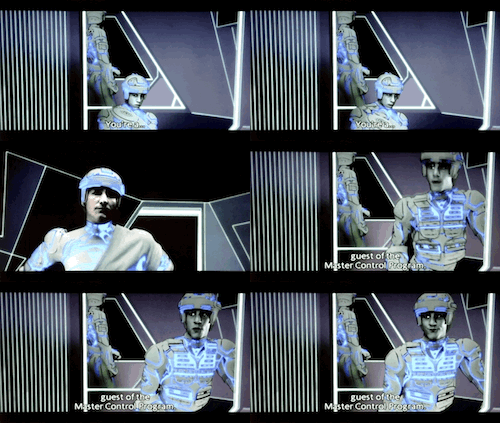
So i don’t think of myself as a knowledgeable scholar of ancient Greece
more an interested observer who enjoys collecting and connecting bits of lore as a hobby…. and has been doing that more and more, as I’ve slid deeper into the very classically-inspired Tron fandom
But one thing that’s intriguing me now:
I’ve posted before about the different kinds of love recognized in ancient Greece (Eros Philia Agape etc) and how I imagine they apply to the Tron world
And I’ve noticed lists of Greek words for love often include Xenia, which a host and guest are supposed to express for each other.
More a code of hospitality rules than an emotion, but definitely an important relationship in ancient Greece
And with Xenia being discussed more and more in the context of that Odyssey adaptation, I’m getting some half-formed thoughts about how Tron (1982) approaches that.
….I don’t exactly have time or energy or even sufficient ideas right now to explore it.
But just based on the discussion I’ve seen, I have a feeling it would be hilarious to try and list all the ways Xenia was violated by… MCP, Flynn, and basically everyone.
go wild.
From Wikipedia:
“Xenia consists of two basic rules:
"The respect from hosts to guests. Hosts must be hospitable to guests and provide them with a bath, food, drink, gifts, and safe escort to their next destination. It is considered rude to ask guests questions, or even to ask who they are, before they have finished the meal provided to them.
"The respect from guests to hosts. Guests must be courteous to their hosts and not be a threat or burden. Guests are expected to provide stories and news from the outside world. Most importantly, guests are expected to reciprocate if their hosts ever call upon them in their homes.”
(additional note, also relevant here: “Sometimes hospitality was unwanted or was given unwillingly,” as when Calypso or Circe tried to keep Odysseus captive)
ok so.
MCP is the worst host ever, of course.
- His “hospitality” is definitely “unwanted,” as he drags Flynn into his world without consent whatsoever. He had no intention of “safely escorting” Flynn to his “next destination”– although that technically is what happened, in the very end, it was fully against the MCP’s plan, which was to make Flynn fight on the Game Grid until death.
- The only arguable “gift” given to Flynn was his suit of program armor, which was arguably not a gift because its whole purpose was for making Flynn fight gladiator battles against his will, and his own clothes were stolen in exchange for it. WTF MCP
- No food or bath was offered, at all– Flynn found the energy pool only after taking much effort to escape the cells and the Game Grid.
- MCP did not technically ask Flynn any questions about himself… but this is only because he already knew all he could want to know about Flynn.
- In fact, this may be the most damning criticism: MCP gave this terrible treatment to Flynn while already knowing that Flynn was, essentially, Zeus Xenios: deity in the disguise of a traveler.
Thus, in my own view, Kevin Flynn’s own violations of Xenia are pretty justified:
- Flynn did not in any way refrain from being a “threat” or “burden.” He fought the MCP the whole time, and ultimately helped destroy it in the process of leaving.
- He did not share any stories about himself with the MCP (though he was not, in fact, asked for any.)
- In the highly unlikely event that the MCP somehow survived the events of 1982 and later came back to Flynn asking for a place to stay, I think we’re all agreed that Flynn would have some very inhospitable choice words about that.
In a sense, Flynn’s relationship with the other programs he met inside the computer was also the relationship of a guest to host. In this specific detail we may be able to draw an analogy to the suitors being reluctantly hosted by Penelope and Telemachus, and how they treated Odysseus and Athena arriving as guests.
(Not similar in any other details, really. Tron, Yori, Crom and Ram were definitely not trying to marry the MCP, and Flynn’s response to meeting them was definitely not any sort of jealous rage. But in a way, they fit the role of established guests responding to the arrival of a new guest– a position where their place in the relationship of Xenia must be considered as both “guest” and “host.”)
(…At least, that is, if we are to consider them “guests” in the same way Flynn was considered a “guest,” during the time when all were held captive unwillingly. Not the only interpretation.)
(More on that later.)
Anyway, if Flynn’s fellow-captives are to be considered among his “hosts” as well as being fellow-guests of the MCP… the treatment of Xenia on both sides here is slightly better.
- Tron and Ram, and eventually Yori, did help Flynn get safely to his next destination.
- Tron and Ram brought him to the energy pool (potential bath and food, although such things don’t translate exactly) as soon as it was possible to do so. They didn’t give him any physical objects as gifts, but this is likely just because, as prisoners, they had none to give.
- Ram broke the code by asking about Flynn’s past, before the offering of nourishment. This would not be considered rude in most real-life present-day societies, and it’s uncertain what rules, if any, existed in the program world, but it still probably counts as a violation if we are judging these encounters according to Xenia.
- Flynn, in turn, broke the code in response, by withholding any information about himself beyond his name.
- Tron broke the code by asking Flynn how he knew Alan’s name.
- Flynn broke the code then, too, by responding with lies about being a program, instead of true stories from the world outside.
- (Both Ram’s and Tron’s violations here were in response to Flynn initiating the encounters. So Flynn may bear some of the responsibility for the exchange not going according to code.)
- Only later, on the Solar Sailer, did Flynn offer true answers to any questions about himself and his life outside, and it was still the vaguest possible information.
- As to being a “threat” or “burden”– Flynn did make choices that resulted in the programs being put in danger (helping break out of the Lightcycle grid), but these were choices that the programs gladly accepted because they also offered a chance at freedom. He also actively protected programs from harm, as when he redirected the solar sailer.
- Also, the one time he was ordered to kill one of his fellow-captives, he actively refused. (He did kill a few on the red-circuited team, including at least one by accident, which may be additional counts against his respect for the MCP’s hospitality. For what little that’s worth.)
- (As for reciprocal hosting in the event of the tables being turned– Flynn does, later, in Legacy, offer a sort of hospitality to Tron, “hosted” on his own server. But I am, for many reasons, less enthusiastic about that, and suspect that this hospitality was in many ways more similar to what the MCP did to him. A whole different rant, beyond the scope of this.)
- The 1982 movie’s final kiss between Flynn and Yori is… complicated in terms of Xenia. To seduce the wife of one’s host would be a pretty clear violation, I’d think, in pretty much any Hellenistic tale.
- But in the context of the computer world, it is pretty strongly suggested that programs didn’t have that type of intimacy before. It didn’t have the connotations it does to a human. In fact, Yori seemed to take it as a gift– and immediately went to share that gift with Tron afterwards, who accepted it gladly.
- So, for once, Flynn actually went above and beyond the guest’s role in Xenia— by being the only one in this whole mess who actually gave a gift, despite that being the host’s job.
Which brings us to the alternate interpretation.
It may actually be more apt to assign the roles of guest and host differently.
My interpretations, up until now, have focused on the MCP’s captives being his unwilling “guests” during their imprisonment. However, before that, the MCP could be seen as the unwelcome “guest” who took over their house.
The ownership of the “house,” the Encom computer itself, is a messy thing, as corporate ownership tends to be. So is the question of who counts as a rightful inhabitant of it.
The MCP had canonically been there a long time –“since he was just a chess program”– but had only in recent times become a menace and begun to claim the place as his own. As a chess program, he’d likely been there long before Yori or Tron, let alone Crom or Ram.
He had also been there back when Flynn was an inhabitant of sorts, previously. (“Remember those times we used to spend playing chess together?”)
However, I would argue that he had changed so much since the chess-program days that… the parable of Theseus’s ship applies here.
And the villain who incrementally replaced that chess program could, in my view, reasonably be considered an unwelcome “guest” who abused the hospitality of everyone else involved– including all the programs and even Flynn himself, by contributing to Dillinger’s eviction of him from the shared “home.”
The ways this may change the analysis of Xenia violations here is an exercise left to the reader– because I have to go to bed.
thanks.