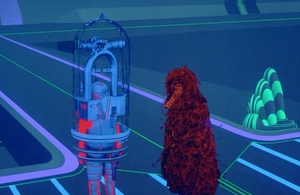
Tron questions:
1) if programs look like their users - as we see with Tron, Yori, Clu and the like - why do some programs, like Dyson, not look like their users? can they change their physical appearances? can their users??
2) if a user was trans, would the program take on the appearance of the user pre-transition, or the appearance of the user at the time of their creation?
3) do programs even have a concept of sex and gender? can a program be trans independent of their users identities??
Oooh! Some of my favorite stuff to speculate about!
Personally I am very 1982-focused, and that first movie is the one where it’s most clear that programs look like their Users. The programs in the Encom system – Tron, Ram, Yori, Sark, Sark’s lieutenant, Dumont, and Clu1– are all played by the same actors as Users who are implied to be their creators.
(Sometimes the implication is very subtle, but the User in question is always shown in a role that the Program’s role could be seen as an “echo” of. We only see “Popcorn Coworker” for a few seconds in 1982, but the fact that he’s played by Dan Shor, and that he’s Alan’s cubicle neighbor just like their programs are cellmates, is enough to make a clear implication that he’s Ram’s programmer. Same with Sark’s lieutenant and Dillinger’s office assistant Peter.)
But that’s the Encom system, and it’s possible things work differently there.
Legacy, and all the other canon that’s set in Flynn’s new Grid, doesn’t make such a clear implication. Clu is the only program there that looks like Flynn. It tends to be assumed that Flynn created all the programs there except Tron (and the ISOs)… and if that’s the case then perhaps he has a way of individually setting their appearances to be unique, instead of them just following the Encom system’s mysterious magic that makes the appearances of programs reflect their strange mystical bond with their User.
Personally, though, I like to imagine that Flynn didn’t create them all. And that they do resemble their creators, but those creators are from all over the world, their work being crowdsourced through some code repository Flynn set up. (In my latest fanfic I called it “Gridhub,” and posited a bunch of lore that explains some things about multiple characters, including Zuse and the Sirens.)
My own headcanon about the Mysterious Program-User Bond is that it causes the program to echo the user’s ideal appearance, more than the actual. So, yeah, the program of a transgender programmer could end up looking different from the programmer (especially if the programmer was not yet free to transition in real life).
And the program’s appearance could change as the programmer’s own view of their ideal appearance changed over time. I think such changes would be more likely if the connection was well-maintained (that is, if the user regularly communicated with and upgraded the program).
I also imagine that changes could occur that reflected the natural aging of a programmer (again, if the relationship was close and well-maintained). My evidence for that is Gibbs and his program Dumont, who is said to be “old enough to remember the MCP when it was just a chess program,” meaning that he was probably created when Gibbs was visibly younger. They seem to have aged together.
(As for the MCP, we briefly see what appears to be his original form at the end as he’s destroyed, and that form is played by the same actor as Gibbs and Dumont. I think the MCP looks so very different from any User because he’s actually got an enormous number of Users. Originally just Gibbs, who wrote him as a chess program; then Dillinger who adapted him to be an administrative program– and then of course he started absorbing lots and lots of other programs into himself to “get bigger,” as Ram put it. And as the MCP himself said, no one User wrote him; he’s worth millions of their man-years– because he now contains the work of so many. By the time of the movie, the MCP is echoing a corporation much more than a person.)
But again, there are many possible interpretations and they all interest me.
There is a storyline in Uprising where some programs are shown to have the ability to change their appearance at will. Also, a storyline in Identity and Catalyst about a group of ISOs called the Automata, who mostly do not look like Users and instead embrace what they consider their “true” forms. (we never see those forms, though. Only the Automata who takes humanoid form to interact with other programs– which does indicate that they, too, have the ability to change).
Personally I like the idea that all programs can change their appearance if they want, though it may require special techniques or equipment. In 1982’s Deleted Love Scene, Yori is shown to have this ability to some degree (just changing her outfit, but I personally imagine she could change everything about her render if she wanted, like a whole videogame character creation screen, sliders for the shape of every body part).
As for sex and gender… I like to imagine it’s not quite the same as for humans. Aside from the changeable visual render, i think there’s some energy and data they can perceive about each other through program senses, and some of it is somewhat analogous to human gender identity but it doesn’t translate exactly. It’s mostly an echo of the User, but how closely it echoes probably depends a lot on the kind of program, how they’re written and, again, what sort of relationship they have with their User.
One thing I really love to think about, in the world of Tron programs, is how very, very diverse different programs could be. More diverse than humans – because humans all follow the same basic biology, and evolved and grew according to the same overall processes.
While different programs were created not only by different people, but for different reasons– with different inherent abilities written into their code. In different programming languages, even.
Like. Imagine the possibilities.