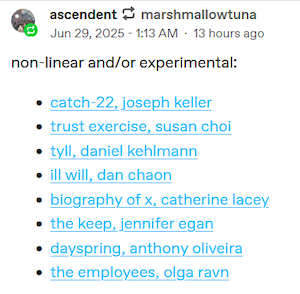
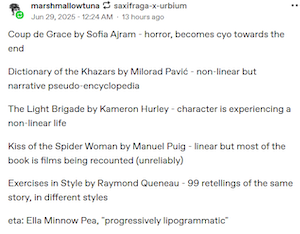
books with non linear narrative, experiments with the form, etc: go!
please do not all say house of leaves i know some of you bitches read books
Alan Moore’s Voice of the Fire: each chapter takes place in the same chunk of London over something like 1000 years
if we can count comics, Moore’s Promethea too, one of the volumes is a trip around the Tree of Life, i think the whole narrative can be mapped on the Tarot Majors too
Mark Danielewski’s Only Revolutions is a book length prose poem that you read from the ends in to the center. i haven’t gotten through it but respect the ambitious structure
i feel like Hal Duncan’s Vellum & Ink had something interesting structurally between them but i don’t think i finished them, specifically bc i waited too long to start Ink after Vellum & got completely lost
Honorable mention/not sure if it counts but the language was interesting enough that I’m tempted to include it: The Tide Will Erase All by Justin Hellstrom is an Improbability Drive-style apocalypse told by a ten(?) year old but might also be a radio/satellite announcement of their story after the fact? needs a revisit
OH SHIT Koji Suzuki’s Ring Cycle. Ring is a horror novel that happens on an entirely different level of operation than what we find out about it on Spiral & Loop
Jeff Vandermee’s Dead Astronauts, i actually don’t know how to describe what he did with it but it’s nuts
The Dictionary of the Khazars is a novel that’s a lexicon
this is turning up a whole bunch of things I hadn’t heard of which is EXACTLY what i wanted god bless you all:
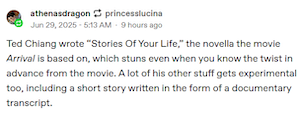
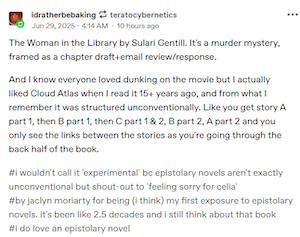
So Stories of Your Life and Others has been on my wishlist for ages as has Pale Fire; Voice of the Fire is on my bookshelf waiting for me and I think I read Promethea or parts thereof when it first came out; I read Catch-22 recently and will rave about it at the drop of a hat, read Cloud Atlas… a couple of years ago I think? After having it on my shelf for a million billion years & dug the matryoska structure muchly, but yeah! Otherwise I hadn’t heard of most of these?!?! excellent work everyone well done
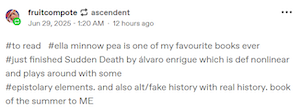
Got a few I haven’t seen in the notes:
Blake Butler’s There Is No Year is decidedly nonlinear, bordering on nonsensical, with upsetting vibes and such perfect pacing that I couldn’t put it down
Matt Bell plays in this territory a lot; pretty much anything by him is going to be fighting you back a little but my introduction was the short story “The Cartographer’s Girl”
John Elizabeth Stintzi takes a pretty oblique approach to structure in Vanishing Monuments and, I understand, in My Volcano. (Disclaimer: they are also a friend of mine, but I make the recommendation in earnest)
The Library at Mount Char by Scott Hawkins is like if Warren Ellis tried to write House of Leaves, and I mean that as a compliment
I’m sure you’re aware of Our Share of Night by Mariana Enriquez, but it is, in fact, all that and a bag of chips, especially in its structure
Monica Ojeda does some fun things with structure, especially in Nefando but definitely also in Jawbone, though I’ll note that Nefando especially deals in some very dark territory
Steven Millhauser’s short stories are pretty distinctly nonlinear and often outright weird in a very fun way – I love his collection The Barnum Museum, notably the source of the short story that inspired the movie The Illusionist
I feel like Ayse Papatya Bucak’s The Trojan War Museum fits here, but I also just feel like that collection is underrated, so cum grano salis
I think the movie is better-known, but Laszlo Krasznahorkai’s Satantango is formally and topically very weird in a way that I found delightful
I also enthusiastically cosign the recommendations of Coup de Grace and Pale Fire. For what it’s worth, Pale Fire is also one of the funniest books I’ve ever read.
I am not aware of Our Share of Night! Also, “bordering on nonsensical, with upsetting vibes” is like catnip. Thank you.
253 by Geoff Ryman (originally published on the web with hyperlinks, later published as a paper book) now at : https://www.253novel.com/
The Bridge by Iain Banks
and
Marabou Stork Nightmares by Irvine Welsh
(both have the dude in a coma)
See Under: Love by David Grossman. It’s in four parts, two of them are straightforward lit fic, one is salmon point-of-view, if I recall correctly, one is a story told in dictionary definitions.
And short stories:
Stet by Sarah Gailey (the story emerges from the footnotes)
Wikihistory by Desmond Warzel (a story in forum posts)
I’m frankly shocked nobody’s mentioned David Mitchell’s “Cloud Atlas,” which is an interconnected set of six stories in different times and with different narrators that are all split in half and work towards the center, like this:
1-2-3-4-5-6-5-4-3-2-1
The stories leave off, sometimes mid-sentence, and resume later in the book, while working forward in time from the first story that’s an Age of Sail story until the 6th one, the only one not interrupted, is in the far post-apocalyptic future. Then each story is resolved in reverse chronological order.
What amazes me about this book (it’s one of my favorites) is that Mitchell somehow makes each of these stories entirely distinct and unique. I don’t know how he managed to write in six such distinct voices to the point that you’d think six writers had collaborated on this work.
Ann Leckie’s Ancillary Justice definitely plays with “when” the narrative is taking place from POV to POV, not to mention playing with the POV itself. The later books become a fair bit more conventional (but no less entertaining for the change) in that regard. I think her later The Raven Tower does some of that as well but it’s been a bit so don’t hold me to that one. (I remember being amazed by what it pulls off, mind you, so it’s another big recommendation.) But definitely, Ancillary Justice.
Time of the Ghost, Diana Wynne Jones. Which of these four sisters is the POV character and why is she a ghost?
Hexwood, Diana Wynne Jones. How many times has this happened and who is it happening to? Does it matter what order it all happened in?
Monday’s Not Coming, Tiffany D. Jackson. Something bad has happened to her friend, the adults are lying, and the pieces of reality don’t fit.
If comics, Elaine Lee & Mike W. Kaluta’s “StarStruck” series. You are just dropped into the world with no explanations. You figure it out as you go. The story & history jump around all over the place. Can now be read for free, here:
Also surprised not to see If on a Winter’s Night a Traveller by Italo Calvino - it opens up with the first chapter of a book and then there an interstitial chapter about someone trying to find the right book and the chapter you just read was an attempt to find it - the book then alternates the first chapters of nonexistent books with the interstitial chapters hunting down the right one
Then non-linear in terms of space, the City & the City by China Mielville plays around with storytelling where the narrative is affected by where the characters are physically
“Liar” by Justine Larbalestier is like… unreliable narrator taken to the absolute extreme. experimental avant-garde levels of unreliable narrator. any line in that book could end up getting revealed to be a lie later on. And then reversed by a new reveal that it was actually true but in a different way. sometimes multiple cycles of this.
hell. I almost expected there to be a reveal at some point saying “none of what I said about myself is true actually, not my name or my age or anything, I totally made up this persona, this isn’t actually my diary at all, it’s a YA novel and I’m actually an author named Justine Larbalestier.”
the lies are that convoluted.
not to that exact point, because that would have made it outright comedy, and it is a very serious book. but it flirts with the border of ridiculousness in a way I found …deeply unsettling and compelling.
yeah it is intended as a YA novel, and the plot does certainly have aspects that reflect this. but I read it in my 30s, and it has NOT left my mind in more than a decade since then, even though my preference is usually for more mature literature.
On Goodreads it’s got a very mid rating… because everyone either loves it or hates it.
Seems to depend on whether the reader actually likes uncertainty, or views a book as pointless if you don’t find out for sure what the truth is in the end.
(in which case, IMO, you’re already wasting your time choosing a book that you know has an unreliable narrator. but especially this book).