 ALT
the thing about the whole wattpad migration is
people who have never actually thought about the process of site moderation, don’t seem to realize that the kind of censorship they want is not only ethically wrong, but logistically impossible on the scale of a large website.
the websites that do have policies banning smut– or banning certain types of it– don’t consistently enforce such bans.
Because consistently enforcing them isn’t possible.
either they have “enforcement” that doesn’t work, and doesn’t really even try to (like here on Tumblr, where completely innocuous posts get censored for no good reason all the time while straight-up porn ads get through unimpeded)
or, they go long times without any enforcement and then have occasional random purges that freak everyone out (seems like this may be what’s just happened with Wattpad?)
actual, reliable enforcement just… wouldn’t work at all. Think about all the definitions you’d have to agree on. Think of the edge cases where mods would have to argue about whether something fit within a certain definition or not.
What counts as sex? What counts as an explicit description? What counts as consensual; how clearly do the characters have to agree to everything? What counts as incest, when all humans are somewhere in the range of 50th cousins or closer? What counts as underage, if the characters’ ages aren’t explicitly stated, or if they live in a world without the same measurements of time, or the same biology of growth? What counts as bigotry, or violence, or an abusive relationship, and what counts as the “author’s endorsement” of whatever’s being depicted?
Think about moderators having to actually read hundreds and hundreds of dark, disturbing fics a week– fics that they might personally find triggering– just to determine which ones actually broke a rule as they defined it.
(Because if they didn’t read them, and just banned the ones that had gotten reported by a certain number of people– then their “enforcement” is at the level that doesn’t even try to work, where the only thing you’d reliably get censored for is being unpopular enough with the nastiest group of bullies.)
if you think for a few minutes about what it would take to actually, reliably keep any particular type of fiction off of a fiction site– you’ll realize it can’t be done. Not beyond the scale of maybe a small website with a few dozen posts a week.
And this is why a site with an anti-censorship ideology like AO3 is the only kind of site that can even come close to reliably enforcing its own rules.
Hell, even with their very small list of offenses that a work can actually be removed for (plagiarism, harassment, commercial promotion, etc) they’ve already got their hands full, and they already run up against a fair number of cases where their decisions get criticized for being unfair.
Because enforcement of rules is always an imperfect endeavor. Rules require definitions, and definitions are imperfect.
So, if you’re gonna make a rule and tackle the task of trying to enforce it, for real– it had better be a rule that there’s a rock-solid important reason to enforce. And that you’ve actually got the time and manpower to enforce on the level it needs.
Anyone who wants websites to do more than that, has not actually given more than a couple minutes’ thought to how running a website works.
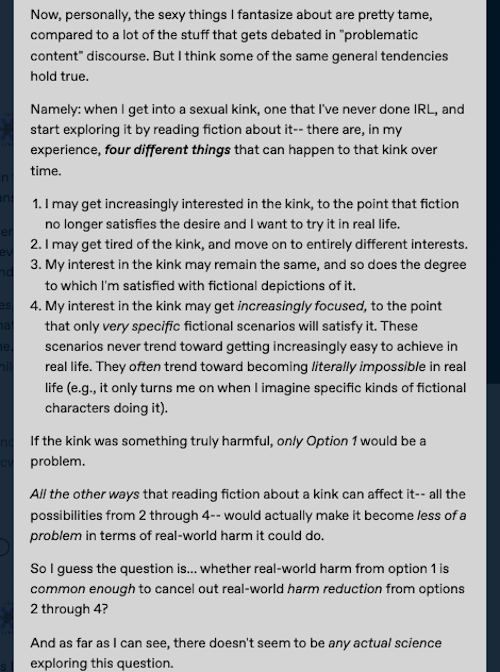
“but we’re not talking about the borderline cases, we’re talking about the ones everyone agrees are clearly just some person’s disgusting fantasy about real-life harmful things they actually want to do!”
ALT